TÜV Approved Truss: What It Really Means (and Why EN1090 Matters More)
If you work in live events, chances are you’ve been asked:\ “Is your truss TÜV approved?”
It’s a question that still appears regularly in tenders, sales calls, and technical discussions. But in today’s regulatory environment, it’s also one of the most misunderstood questions in the aluminium truss industry.
So what does TÜV approved truss actually mean—and is it still relevant when assessing truss safety and compliance?
Why “TÜV Approved Truss” Became an Industry Benchmark
To understand the confusion, we need to look back to a time when no formal standards existed for live event structures.
In the late 1970s and early 1980s, companies such as Slick Systems International Ltd were developing the foundations of modern aluminium truss—introducing fork ends, conical connectors, and modular systems still used today.
At that time, there were:
- No EN standards for live events
- No industry‑specific structural guidance
- No formal certification framework
Taking a safety‑led approach, Slick Systems worked with aircraft engineer Arthur G. Taylor, applying aerospace engineering principles and adopting an internal 3:1 safety factor—highly progressive for the era.
How TÜV Entered the Industry for live events truss standards
As Slick Systems expanded into Germany—a market known for rigorous engineering—there was growing pressure to demonstrate formal compliance.
Through its German distributor, Slick Systems approached TÜV (Technischer Überwachungsverein) to inspect and certify its truss against existing DIN standards for structural aluminium.
This was revolutionary at the time. No other manufacturer had sought national aluminium truss certification, and by the 1990s, Slick truss had become TÜV approved.
Naturally, this approval became a powerful marketing signal of quality, especially across mainland Europe.
Why Everyone Started Asking “Is Your Truss TÜV Approved?”
As the live events market grew, new truss manufacturers followed suit. TÜV approval:
- Built customer confidence
- Differentiated new brands
- Helped justify purchasing decisions
Because TÜV is a certification body (and a private company), it expanded its inspection services into this growing sector. Over time, “TÜV approved truss” became an industry shorthand for quality and safety.
But the industry didn’t stand still.
Is TÜV Approval Still Relevant Today?
Yes—but only in context.
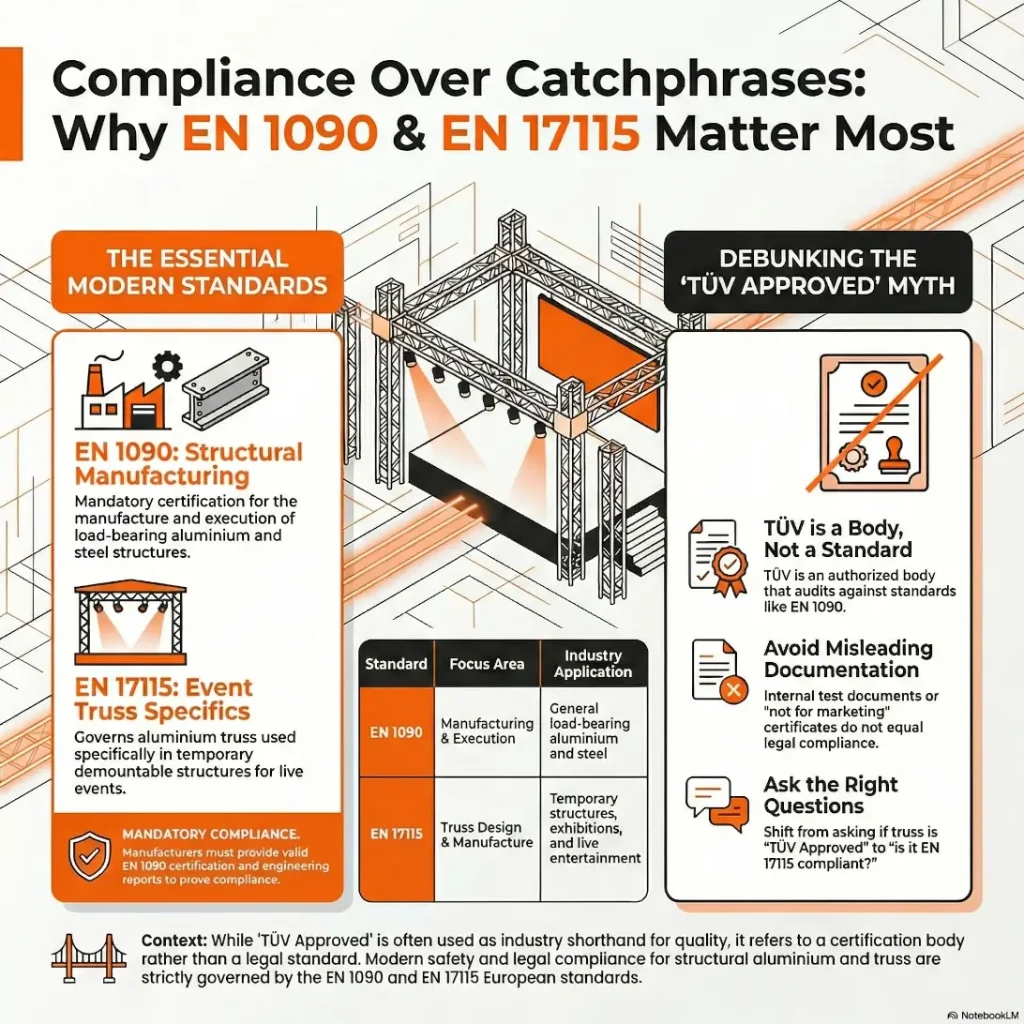
A critical point often overlooked is this:\ 👉 TÜV does not create standards.
TÜV is simply one of many authorised bodies that can inspect and certify compliance against standards set elsewhere.
Today, structural standards for aluminium truss and temporary event structures are defined at a European level by CEN, not TÜV.
The key standards are:
✅ EN 1090 – Structural Aluminium Certification
EN 1090 governs the manufacture and execution of aluminium (and steel) structures. Any company producing load‑bearing truss must be EN1090 certified.
✅ EN 17115 – Manufacture of Aluminium and Steel trusses
EN 17115 applies specifically to the manufacture of aluminium truss used in temporary demountable structures for entertainment, exhibitions, and live events.
Any accredited certification body can audit against these standards—and TÜV is just one option.
The Right Questions to Ask a Truss Manufacturer
Instead of asking “Is your truss TÜV approved?”, the correct modern questions are:
- Are you EN1090 certified?
- Is your truss EN17115 compliant?
A manufacturer meeting today’s regulatory expectations will be able to:
- Provide valid EN1090 certification
- Demonstrate EN17115 compliance
- Clearly identify the certifying body (TÜV or otherwise)
The Risk of Misleading TÜV Claims
Unfortunately, vague claims of “TÜV approval” are still widely misused.
We have seen cases where:
- Internal test documents are presented as certification
- Certificates clearly marked “not for marketing use” are sent to clients
- Structural tests are used without accompanying engineering reports
In extreme examples, documentation containing disclaimers and errors has been used to justify large‑scale event structures.
This is where buyers must exercise caution.
Conclusion: TÜV Approval Is Not the Same as Manufacturing Compliance
A competent, professional truss manufacturer will not lead with “TÜV approved.”
Instead, they will clearly state that they are:
- EN1090 certified, and
- EN17115 compliant
They will also provide clear, current documentation to support those claims.
So next time you hear “TÜV approved truss,” don’t stop there.\ Ask the questions that actually matter.
Be careful out there.
Need to know more about our aluminium truss certification? You can find us registered on the EN1090 Portal here,
For more of our knowledge articles click here.