
The Origins and Development of Forkend and Taper (Conical) Truss Connectors
Introduction
Aluminium truss systems, widely used as modular structural elements in the live event industry, have a fascinating history rooted in British engineering innovation. The evolution of forkend and conical (taper) connectors can be traced back to a blacksmith workshop in Leek, Staffordshire, England.
The Birthplace of Modern Truss Connectors
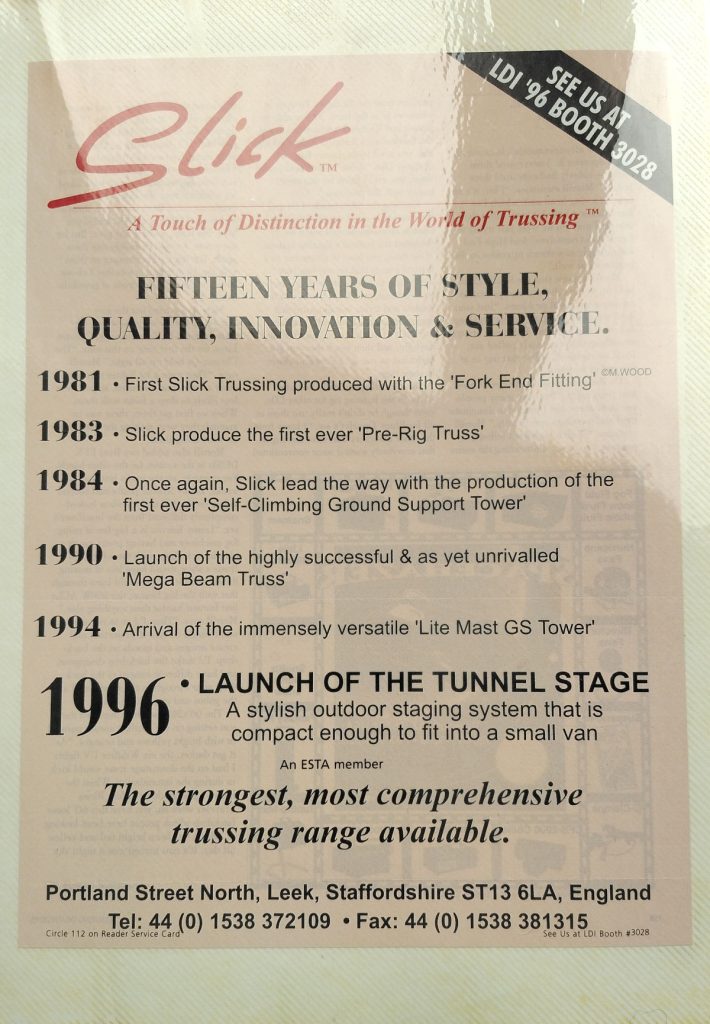
The story begins with Mike Wood, a skilled metalworker at Trader Horn Welding. Through a sequence of events, Wood and his workshop found themselves involved in the entertainment industry. This venture ultimately led to the formation of Slick Systems International Ltd, a company from which all modern pinned connectors for modular truss systems originate.
The Forkend Connector
The early forms of the forkend connector emerged in the UK as far back as 1981, as part of a product known as Minibeam—a rectangular truss built from 48mm UK aluminium scaffold tube. Designed initially for a car product launch, a subsequent square version called GS truss became especially popular with customers across mainland Europe. Developed in the late 20th century, these connectors adapted concepts from other industries, miniaturising and refining them in aluminium to achieve precise tolerances and minimise deflection.
A 5/8” hole size was chosen, aligning with a standard UK reamer, before metric sizing became widespread. Pins were engineered to be just 0.05mm under the hole diameter, ensuring a near-perfect fit. As other manufacturers began to replicate the design—sometimes exactly—they also adopted this imperial sizing. Although some later shifted to a 16mm diameter hole, this increased joint deflection as the pin size remained unchanged for backwards compatability. Decades later, American manufacturers also adopted this connector type, with the main alteration being an increase to a ¾” (19mm) hole. Despite this, the core design remains remarkably similar to the original 1981 Slick products.
The Taper (Conical) Connector
Commonly referred to today as a conical truss connector, the taper connection was another innovation from Slick Systems International. It addressed the need for a more robust and professional solution for lightweight, triangular truss. Previous products were either bolted or used traditional scaffold sleeves, both of which resulted in significant joint deflection and vulnerability to damage.
Inspired by the Morse taper joints used in precision machinery, Slick introduced the ‘taper fitting’ in the live events sector in 1984 with the Slick Litebeam product. This connector used a tapered pin to draw the joint together, producing an extremely rigid connection. Thanks to this innovation, load span tables no longer had to consider joints as the weakest point in the truss, as the taper fittings provided exceptional strength and reliability.
Fun fact, ever wondered why most Triangle and square trusses are classed are 290mm. This is because the original Slick Lite beam was designed to be 240mm ctrs, which actually shrunk to 237mm after welding, and then everyone copied what was a the time the industry size for that type of truss product. (Original slick Lite beam had a main cord of 2” and was later changed to 48mm)
Industry Impact and Legacy
The principle of the taper fitting, now widely called the conical connector, has become ubiquitous in the live events industry. Slick’s pioneering designs set the benchmark for truss connectors, with their principles and geometries forming the reference point for nearly all subsequent manufacturers worldwide. Today, modern truss producers continue to use, adapt, or build upon the original Slick connector concepts—be it forkend pins or conical/taper fittings.
Recent Developments
In 2003, Total Fabrications Ltd acquired Slick Systems, inheriting its wealth of knowledge and innovative legacy. The spirit of innovation in truss connector design continues to thrive under that ownership, ensuring that these foundational British inventions remain at the heart of the live event industry’s structural solutions.
You can find all our trusses using the original Slick forkend connector along with our conical connectors here.